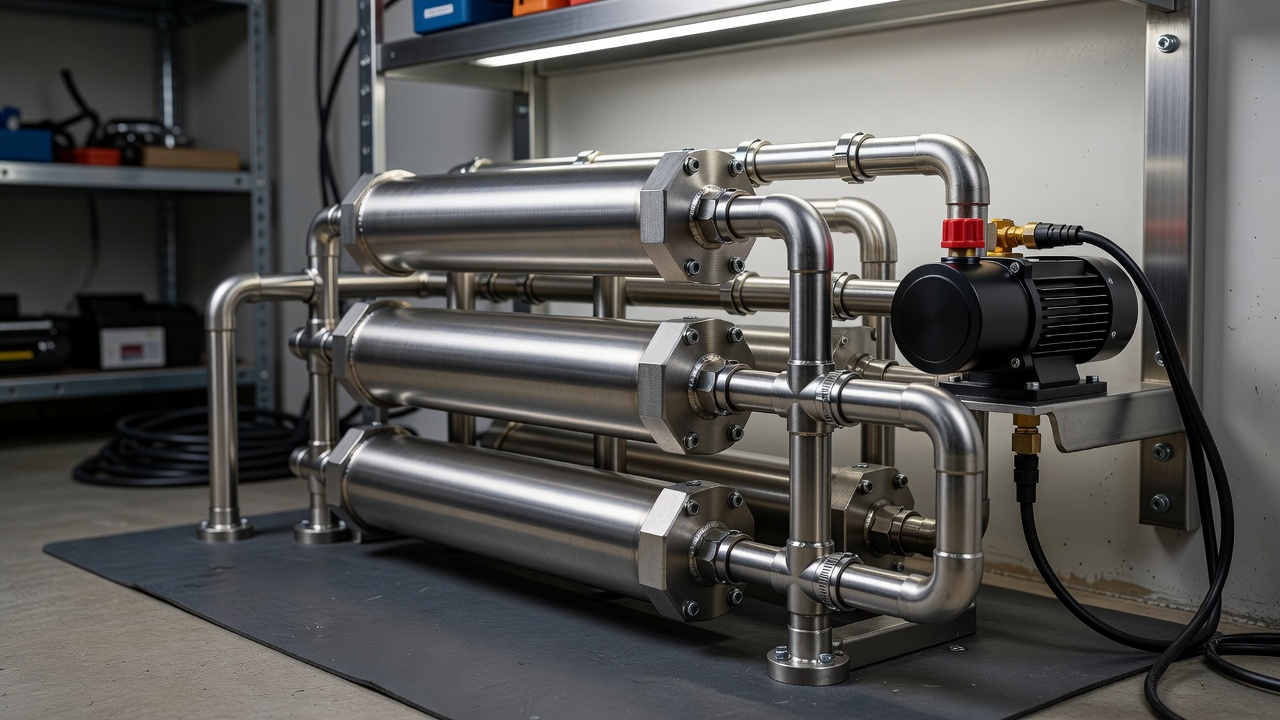
Roof Hydrology & Collection Metrics
A typical 28-foot tiny house roof footprint provides approximately 250 square feet of horizontal catchment area. In a temperate climate receiving 40 inches of annual precipitation, this surface captures approximately 5,600 gallons of water per year. The collection system uses food-grade silicone-sealed aluminum box gutters connected through a first-flush diverter.
The first-flush chamber isolates the initial 10 gallons of any rainfall event, trapping airborne pollen, particulates, and organic roof debris before water flows into the main insulated belly storage tank.
Three-Stage Potable Filtration Schematic
| Filtration Stage | Filter Media | Pore Rating | Target Contaminants |
|---|---|---|---|
| Stage 1: Sediment | Spun Polypropylene | 5.0 Micron | Sand, Silt, Rust Particles |
| Stage 2: Adsorption | Extruded Carbon Block | 0.5 Micron | Chlorine, Volatile Organics, Odors |
| Stage 3: Sterilization | High-Output UV-C Lamp | 254 nm Wavelength | Bacteria, Viruses, Giardia, Cysts |
Blackwater Elimination via Composting
Blackwater—effluent containing human waste—requires complex municipal sewer hookups or large septic drainage fields that restrict site placement. Our micro-home layout eliminates blackwater entirely by specifying a waterless urine-diverting toilet (UDT).
Liquid fraction is routed directly to a designated absorption trench or nitrogen-dilution container, while solid compostable matter falls into a sealed negative-pressure chamber vented by a continuous 12V 2-watt exhaust fan. This desiccates the waste, completely suppressing odor formation and yielding safe organic compost within a 6-to-9 month aerobic breakdown cycle.
Solar Balance of System (BoS) Integration
The electrical network operates primarily at a native 48-volt DC direct bus architecture. Rather than stepping 12V battery power up to 120V AC only to step it back down for laptop charging, LED drivers, and refrigeration, DC sub-panels supply these high-efficiency loads directly. This reduces inversion parasitic losses by up to 18%, extending off-grid battery autonomy during winter low-sun cycles.